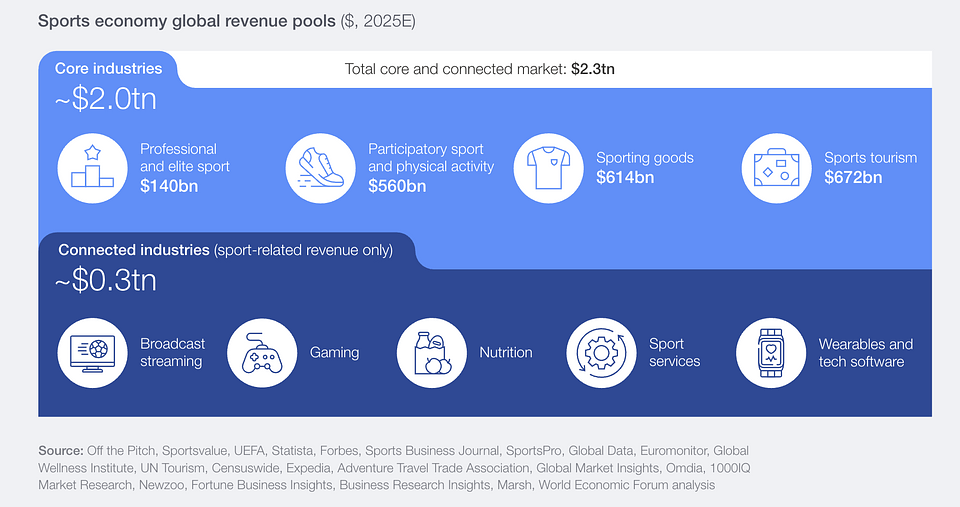
The report presents the first comprehensive market sizing of the global sports economy with sporting goods valued at $614 billion – a quarter of the overall number.
- Physical activity is highlighted as a powerful yet under-leveraged driver of long-term economic resilience, public health and sustainable growth.
- However, under current trajectories the interconnected pressures of physical inactivity, climate change and nature loss could reduce the global sports economy’s annual revenue by up to 14% ($517 billion) by 2030, rising to 18% ($1.6 trillion) by 2050.
- This amounts to $168b Revenue at Risk for the Sporting Goods Industry by 2030.
- The report calls for bold leadership, strengthened governance and deeper collaboration across public, private and civil society actors to keep global sports economy growth on track.
Bern, 15th January 2025 - The World Federation of the Sporting Goods Industry (WFSGI) today welcomed the publication of the World Economic Forum’s Sports for People and Planet Insight Report presenting the first comprehensive market sizing of the global sports economy.
Currently valued at $2.3 trillion annually, the global sports economy is projected to grow to $3.7 trillion by 2030 and $8.8 trillion by 2050. Making up a quarter of this number is the sporting goods industry, valued at $614 billion.
Produced in collaboration with knowledge partner Oliver Wyman, the report highlights physical activity as a powerful yet under-leveraged driver of long-term economic resilience, public health and sustainable growth.
However, the report warns that that the combined impacts of physical inactivity, climate change and nature loss significantly threaten long-term growth across the global sports economy estimating that the sporting goods industry risks losing $168 billion in projected revenue alone by 2030.
According to the World Health Organisation, if current trends persist, global physical inactivity rates among adults are projected to rise to 35% by 2030, which the report estimates, would result in up to 800 million fewer active people worldwide than previously anticipated.
Industry Challenges and Opportunities
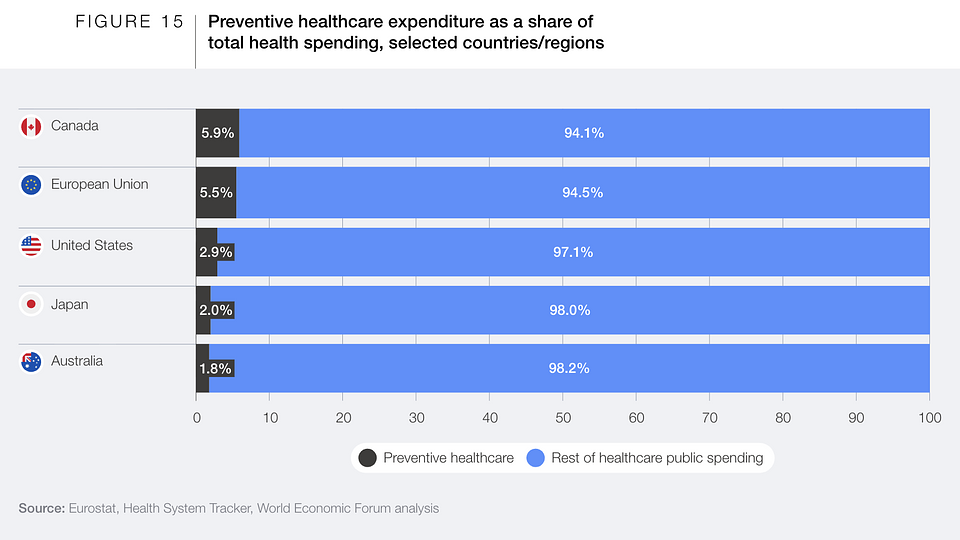
Despite strong evidence that sport, physical activity and movement reduce the risk of non communicable diseases, government spending on preventive healthcare remains low relative to the scale of inactivity-related health costs and is under further threat due to increased spending on defence and crisis response.
Between 2020 and 2030, inactivity is projected to cost global healthcare systems approximately $300 billion, while preventive health spending – including investment in physical activity – accounts for less than 6% of total health expenditure across major economies.
While this trend presents a clear challenge, the report emphasises that it also represents a major economic opportunity. The report positions sport, physical activity and movement as forms of preventive medicine, noting their potential to reduce the burden of non-communicable diseases, improve workforce productivity and support more resilient economies over the long term.
Gaps in sports and activity participation are identified as a source of untapped growth. In the European Union, women and girls account for just 37% of sports participation, signalling significant potential to expand engagement and strengthen the future consumer base of the sports economy.
The report also highlights the role of cities and built environments in shaping participation, noting that access to safe, inclusive and climate-resilient spaces is critical to increasing sport, physical activity and movement at scale: 'Environmental degradation discourages physical activity, while less active populations are more susceptible to climate-related health impacts'. As cities generate around 80% of global GDP and house the majority of the world’s population, the design of urban environments - including proximity to facilities, active transport infrastructure and access to natural spaces - is increasingly recognised as a determinant of both public health and economic productivity.
The Role of the World Federation of the Sporting Goods Industry and its Members
WFSGI is recognised in the report for its collaboration with the World Health Organization to promote sport, physical activity and movement globally, reflecting the federation’s role at the intersection of industry, health and sustainability.
Emma Zwiebler, WFSGI CEO says: “This report reinforces what our industry increasingly understands: physical activity and movement is not only a public health priority, it is an economic enabler and critical to the future growth of the global sports economy. When participation grows, the benefits extend across healthcare systems, productivity, inclusion and long-term industry growth.”
The report also highlights leadership from WFSGI member companies including Nike, adidas, Decathlon and Puma, citing initiatives that encourage sport, physical activity and movement and support sustainable business models through circularity initiatives, sustainable materials and resource stewardship.
“It’s clear that healthier populations and more resilient environments expand markets rather than shrink them. The opportunity now is to scale what works,” Zwiebler added. “By aligning industry action, ESG initiatives and public investment, sport, physical activity and movement can play a far greater role in delivering healthier societies and more resilient economic growth.”
The WFSGI looks forward to continued collaboration with the World Economic Forum and partners beyond Davos to help translate insight into action and unlock the full potential of the global sports economy.
END
About WFSGI The World Federation of the Sporting Goods Industry (WFSGI) is the global, not-for-profit trade association for the sporting goods industry. WFSGI is officially recognised by the International Olympic Committee (IOC) as the industry representative within the Olympic Movement. Our members comprise of sports and sports-inspired leisure brands, manufacturers, suppliers, retailers, national/regional federations, industry and trade associations. This represents approximately 70% of the global industry by annual turnover. The purpose of the WFSGI is to unite and support the global sporting goods industry, and ensure a healthier, more active planet for all. www.wfsgi.org
Contact: hello@fiolafoley.com +353 87 032 5565 for interviews and additional commentary from WFSGI
The report can be read in full and downloaded here: https://www.weforum.org/publications/sports-for-people-and-planet/